- "The law" that Jesus fought is probably NOT what you think. It is not the 10 commandments nor is it Leviticus, nor is it even in the Old Testament. In fact, the context in which Jesus talks about "The Law" wouldn't even make sense if it were the the law in the Old Testament. Jesus did not die so that we could eat shellfish. "The Law" was intentionally left out of the bible. Although intentions were good to omit it, the lack of understanding can possibly hinder modern Christians from fully understanding and accepting what it meant for Jesus to walk among the people in which he did.
- During the Exodus from Egypt, It was AT LEAST 20 years BEFORE the Hebrews reached the Red sea. It wasn't right outside the city gates of Goshen as "Prince of Egypt" leads us to believe.
- This means that Egypt waited 20 years before attacking, as there is a tremendous amount of proof showing this happened as they were crossing the sea. The only reason why they attacked at that time is because the Red Sea was the Egyptian border. Once the Hebrews crossed the border, they would no longer be slaves. The Egyptian army didn't care about them until they got to this point.
- Moses waving his wand over the water did not separate the sea. A leap of faith needed to be taken that Moses did not take. While the Hebrews were panicking and wailing, Nahshon walked out into the water. As soon as he got nose deep, the Sea parted. God required somebody to take a step of faith.
Overview: At first glance of the old testament, we often don't link it to Jesus. There is a reason for this that I will introduce shortly below but it is very important to note that while all of the Old Testament stories are occurring, Jesus' ancestors are alive. Sometimes they are the main character of the stories and sometimes they are in the background, and sometimes they are not even mentioned...but they are still alive and living and dying.
Enter: Hebrew Documents.
As I said in my introduction, there are several things that occured around this time that are not in the Christian Bible. They are written in Hebrew texts. The reason why they are not in the Christian bible is because they don't promote Christianity. Some of you might ask, "Why read it then?". My answer to you is "It is the catalyst and precursor to the Christian bible. The state of the Hebrew nation needs to be understood so that we can fully accept our faith in Jesus's walk and accept why he came.
Here are some documents that we need in order to fully understand the Gospel of the new testament:
-Torah: many of us are familiar with. It contains the following sections:
Don't worry. The Talmud is still accessable, alive and well:
I don't post these in judgement in any way. I am just posting them to demonstrate that the Talmud is a real living document that has never gone anywhere.
Now you are probably starting to understand the culture and the idealology that Jesus was pitted against in his ministry. We will get into more of that later. I just wanted to ensure that my point is made that the Talmud in no way benefits Christ-followers Post-Christ times, however it adds a great deal of depth to the reason that Jesus was sent.
As I said in my introduction, there are several things that occured around this time that are not in the Christian Bible. They are written in Hebrew texts. The reason why they are not in the Christian bible is because they don't promote Christianity. Some of you might ask, "Why read it then?". My answer to you is "It is the catalyst and precursor to the Christian bible. The state of the Hebrew nation needs to be understood so that we can fully accept our faith in Jesus's walk and accept why he came.
Here are some documents that we need in order to fully understand the Gospel of the new testament:
-Torah: many of us are familiar with. It contains the following sections:
- Bereshit (Genesis)
- Shemot (Exodus)
- Vayikra (Leviticus)
- Bamidbar (Numbers)
- Devarim (Deuteronomy)
According to the Midrash (see below), the Torah was created and to be used as a blueprint of creation.
-613 Mitzvot: This is the law of Moses. These are the laws that Moses used to define the newly developed tribes once it was outside of the law of Egypt.
-Talmud: The written compendium of the Jewish oral law. It is a compilation of legal debates that was created to define "What is it that God really wants of the Jews?". Imagine our law system. Imagine the library in which all of our countries laws and orders are kept. The Talmud is this: The constitution and all of the conversations (legal battles) that have defined the culture to be as it is. It contains 3 sections:
http://www.sacred-texts.com/jud/talmud.htm
http://www.sacred-texts.com/jud/talmud.htm
- Mishnah. Written compendium of Jewish oral law: Compilation of legal opinions and debates. It contains the following sections:
- Zeraim (Seeds) - Deals with prayer, blessings, tithes, and agriculture
- Moed (Festival) - Laws of the sabbath and festivals
- Nashim (Women) - Deals with marriage, divorce, and oaths
- Nezikin (Damages) - Outlines procedings for civil and criminal law
- Kodashim (Holies) - Laws regarding sacrifices, the temple, diet
- Tehorot (purity) - Dealing with the dead, purity of food, purity of the body.
- Baraita
- The amendments made to the Mishnah
- Gemara
- Legal analysis of the hebrew bible. This is the ongoing, living document that defines the culture based on the Mishnah.
Why is the Talmud never mentioned in anything that we have learned? The Talmud does nothing to benefit Post-Christ times. If you understand those times, you understand that there are Jews (goys) and gentiles. Jews were the chosen race and gentiles were filth. The Talmud is written as such and does nothing to promote Christ's message that everybody is invited to God. Here are some fun, entertaining examples:
-Moed Kattan 17a: If a Jew is tempted to do evil he should go to a city where he is not known and do the evil there.
-Erubin 21b. Whosoever disobeys the rabbis deserves death and will be punished by being boiled in hot excrement in hell.
-Sanhedrin 58b. If a heathen (gentile) hits a Jew, the gentile must be killed.
-Sanhedrin 57a . A Jew need not pay a gentile the wages owed him for work
-Baba Kamma 37b. If an ox of an Israelite gores an ox of a Canaanite there is no liability; but if an ox of a Canaanite gores an ox of an Israelite...the payment is to be in full.
-Baba Mezia 24a . If a Jew finds an object lost by a gentile ("heathen") it does not have to be returned.
-Sanhedrin 57a . When a Jew murders a gentile, there will be no death penalty. What a Jew steals from a gentile he may keep.
-Moed Kattan 17a: If a Jew is tempted to do evil he should go to a city where he is not known and do the evil there.
-Erubin 21b. Whosoever disobeys the rabbis deserves death and will be punished by being boiled in hot excrement in hell.
-Sanhedrin 58b. If a heathen (gentile) hits a Jew, the gentile must be killed.
-Sanhedrin 57a . A Jew need not pay a gentile the wages owed him for work
-Baba Kamma 37b. If an ox of an Israelite gores an ox of a Canaanite there is no liability; but if an ox of a Canaanite gores an ox of an Israelite...the payment is to be in full.
-Baba Mezia 24a . If a Jew finds an object lost by a gentile ("heathen") it does not have to be returned.
-Sanhedrin 57a . When a Jew murders a gentile, there will be no death penalty. What a Jew steals from a gentile he may keep.
-Baba Kamma 37b. The gentiles are outside the protection of the law
and God has "exposed their money to Israel."
-Yebamoth 98a. All gentile children are animals.
-Abodah Zarah 36b. Gentile girls are in a state of niddah (filth) from birth.
-Hagigah 27a. States that no rabbi can ever go to hell.
-Menahoth 43b-44a. A Jewish man is obligated to say the following prayer every day: "Thank you God for not making me a gentile, a woman or a slave."
-Yebamoth 98a. All gentile children are animals.
-Abodah Zarah 36b. Gentile girls are in a state of niddah (filth) from birth.
-Hagigah 27a. States that no rabbi can ever go to hell.
-Menahoth 43b-44a. A Jewish man is obligated to say the following prayer every day: "Thank you God for not making me a gentile, a woman or a slave."
Don't worry. The Talmud is still accessable, alive and well:
Now you are probably starting to understand the culture and the idealology that Jesus was pitted against in his ministry. We will get into more of that later. I just wanted to ensure that my point is made that the Talmud in no way benefits Christ-followers Post-Christ times, however it adds a great deal of depth to the reason that Jesus was sent.
...You will see me refer to the above at given points during this study. I feel that they are VERY important to understand the gospel of Christ because we see many amazing things done in the gospel, but we don't fully understand why they are there. If we know that these documents exist and can read them at any given time, we can see why so many people were blown away by the things that Jesus said.
Get onto the Geneology, already!!!!
Ok. Now that we got all of that out of the way, let's get onto the good stuff. Below is the list of the first 14 of Jesus' lineage:
- Abraham
- Isaac
- Jacob
- Judah & Tamar
- Perez
- Hezron
- Ram
- Amminadab
- Nahshon
- Salmon
- Boaz & Ruth
- Obed
- Jesse
- King David
If you follow the next post, you will learn some VERY INTERESTING things about the time period between Abraham and King David...especially in the timeframe of Egypt.
- Abraham
- We all know Abraham. I'm not going to go too much into him as we have known who he is throughout our lives. He finally had his son Isaac and was willing to sacrifice him for God. God rewarded him for his desire to please God.
- Isaac
- Survived his fathers willingness to sacrifice him.
- We all know Isaac
- Was tricked into giving birthright to wrong child
- Jacob
- Stole Esau's birthright.
- We all know Jacob.
...Now this is when Jesus' Lineage begins to diverge from the bible stories we all know and love. While the bible follows Joseph, we are going to follow Judah.
- Judah and Tamar
- Judah is the brother of Joseph who suggested selling him to the slave traders.
- Judah was married and had 3 kids - Er, Onan, and Shelah.
- Tamar originally married to Er (Judah's son)
- God killed Er.
- Tamar was then married to Onan.
- God killed Onan.
- Out of fear of losing his last son, Shelah, Judah would not let her marry him.
- You can see the conflict in which she needed to marry a male from Er's family, but Judah was hesitant to have her marry.
- She overcame this conflict by dressing as a prostitute and tricking Judah (Er's father) into having a child with her.
- She got twins.
- Perez
- First twin to come from the womb of Tamar.
- There is nothing else about Perez, other than the fact that he had 2 sons; One of which being Hezron
- Hezron
- Youngest to move to Egypt with Jacob.
- Only appears in geneology lists
At this point, Joseph moved the 4 generations from their place of famine into Egypt. Jacob, Judah and his brothers, Perez and Hezron.
- Ram
- Lived while still in Egypt.
- Nothing other than geneology lists
- Amminadab
- Born during exile from Egypt.
- Nahshon
- The initiator who caused the Red Sea to part.
- His sister married Aaron, which led to Aaron's fame - "One should select a wife who's brother is noble."
- Did not survive into the promised land
- Appointed by Moses to lead Judah.
Nahshon is the point in which the stories come back together. He is not mentioned in the Christian bible, however he is the reason why Jesus' lineage was brought up to be Kings. He is mentioned in the Gemara, and this is the act that made him Tribe-Leader worthy.
Nahshon is seen in Jewish religion as a David and Goliath character. He stepped into the sea in faith when nobody else would.
http://www.amazon.com/Nachshon-Who-Was-Afraid-Swim/dp/0822587653
Here are the Midrash to translate:
http://realiajudaica.blogspot.com/2011/04/nachshon-ben-aminadav.html
Nahshon is seen in Jewish religion as a David and Goliath character. He stepped into the sea in faith when nobody else would.
http://www.amazon.com/Nachshon-Who-Was-Afraid-Swim/dp/0822587653
Here are the Midrash to translate:
http://realiajudaica.blogspot.com/2011/04/nachshon-ben-aminadav.html
You will note that Nahshon's father, Amminadab was born on the exile. Since Nahshon is the one who separated the Red Sea, that means that there were 2 generations (conservatively 20+ years) between the exile from Goshen to crossing the red sea. The Egyptian Army didn't attack the escaping jews for 20 years and that was only because they reached the Egyptian border.
Most people believe the "40 years lost in the desert" was because they were somehow inept in finding their way. We need to remember that the Philistine Land was due East of Goshen. A homeless nation with no resources and embedded elders, women, children would not be able to cross through that land peacefully or through war with success. It was important for the Hebrews to route completely around the Philistine land. This would take 40 years regardless of whether they had a God GPS or not.
I really want to point this out because it is a common misconception (Thanks to "Prince of Egypt" and Charlton Heston) that the Hebrews were attacked as soon as they packed up and left Goshen. This opens the case up for skeptics to say the Red Sea crossing was at a lot of places in which it wasn't.
Most people believe the "40 years lost in the desert" was because they were somehow inept in finding their way. We need to remember that the Philistine Land was due East of Goshen. A homeless nation with no resources and embedded elders, women, children would not be able to cross through that land peacefully or through war with success. It was important for the Hebrews to route completely around the Philistine land. This would take 40 years regardless of whether they had a God GPS or not.
I really want to point this out because it is a common misconception (Thanks to "Prince of Egypt" and Charlton Heston) that the Hebrews were attacked as soon as they packed up and left Goshen. This opens the case up for skeptics to say the Red Sea crossing was at a lot of places in which it wasn't.
This point in Jesus lineage SHOULD eliminate Biblical skeptics who say they crossed at Bitter lake or the Point of Suez. Not only that, but the mentioning of the wilderness and towns between Goshen and the Sea Crossing.
-Based on the actual time frame, it makes this "Red Sea Crossing" Much more likely and realistic:
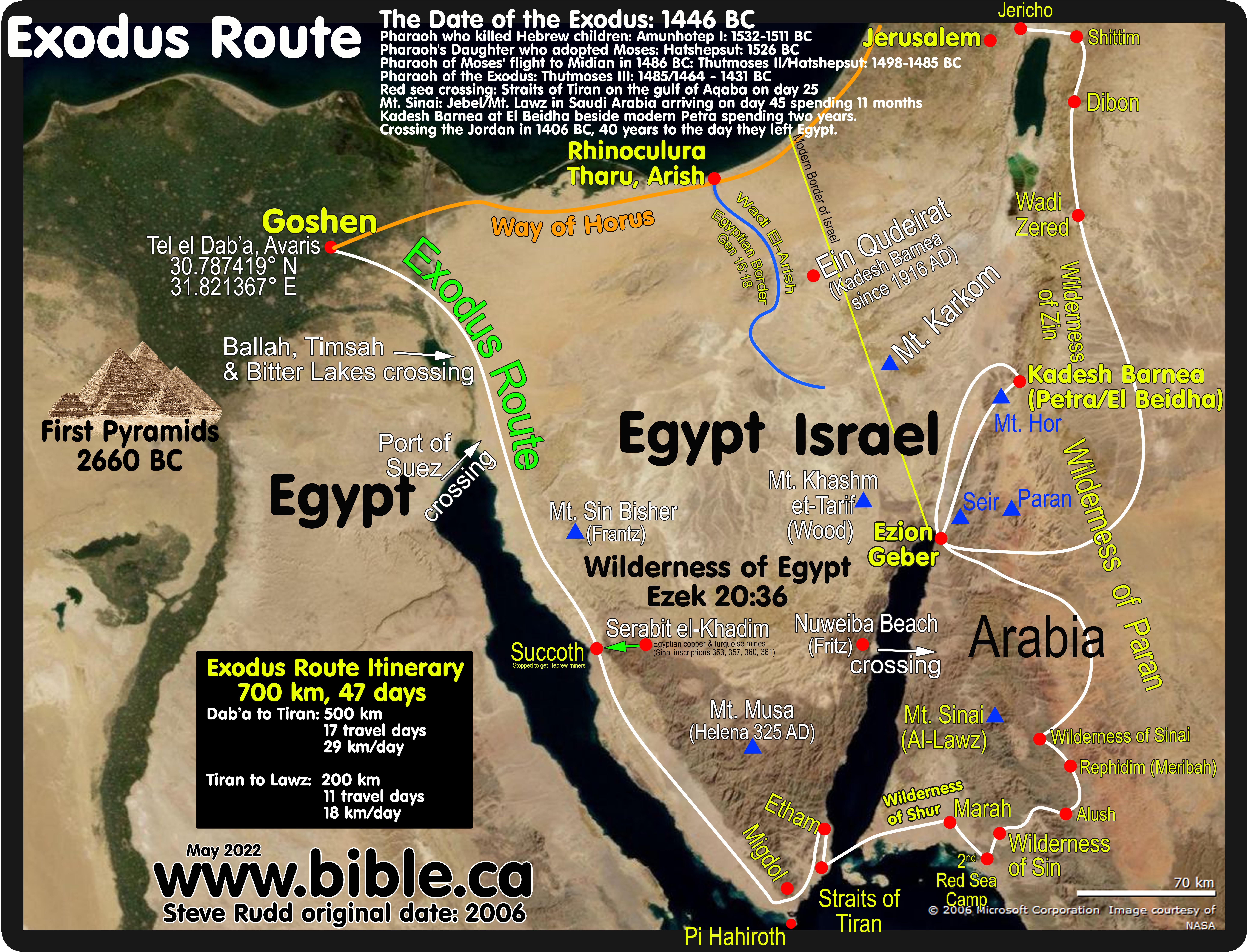
I agree that is a valid place in which the Hebrews crossed. It also validates the Egyptian Army's eagerness to head them off at this point. If the Hebrews crossed the Egyptian border, they would no longer be slaves to the Egyptians. The Army attacking was a last-ditch effort by the Egyptians to keep them from crossing the border (lined by the sea) and becoming "free resources".
- Salmon & Rahab
- Nothing mentioned of him other than he fathered Boaz.
- Rahab was prostitute living in Jericho. Her life was spared as she hid spies in her house to help it be overthrown. She was promised she would be saved.
- Not the same Rahab as in the Talmud.
- Boaz & Ruth
- Became rich land owner
- A man for the people. Very upright and looked out for everybody.
- Ruth was married to Mahlon. Mahlon and his brother were killed. Mahlon's father (Naomi's husband) was dead. She was left without a husband along with Naomi. She and Naomi were widows with no family.
- First in the lineage to be a foriegner. First in lineage to be converted to Judaism.
- Gave birth to Obed
- Obed
- There is nothing about Obed, other than him being the grandfather of David.
- Jesse
- Farmer, Breeder, Sheep owner.
- Had 8 sons. David was the youngest.
- David
- King David is the pivotal character in Jewish, Christian and Islamic Doctrine.
- "A direct descendant of David will be messiah"
- Killed Goliath
- Wanted to build a temple for God.
So that is Jesus' lineage from Abraham up through the first Kingdom.

No comments:
Post a Comment